
As port economic regulatory regime begins, agency management primes workers for new roles
The Director General/CEO of the Nigerian Ports Economic Regulatory Agency, (NPERA), formerly Nigerian Shippers Council, Dr. Akutah Pius, has urged staff to embrace the culture of commitment, and professionalism as the Council transitions from shippers’ council to ports economic regulator.
Speaking at a town hall meeting with staff at the Agency’s headquarters in Lagos, Dr. Akutah said the transition from the Nigerian Shippers’ Council to NPERA demands a shift in both work culture and operational mindsets to deliver effective economic regulation across the nation’s ports.
The meeting was the first Management’s major engagement with employees following President Bola Ahmed Tinubu’s assent to the NPERA Act, 2026.
Akutah described the legislation as a milestone for Nigeria’s maritime sector, saying it strengthened the Agency’s powers to curb unethical practices, improve port efficiency and enhance the country’s competitiveness in regional and global trade.
“The NPERA Act has strengthened our regulatory powers to institute effective regulation at the ports. With this mandate, we are positioned to drive efficiency, transparency and competitiveness in the port sector” he said.
He added that the Agency’s expanded responsibilities would contribute significantly to the Federal Government’s ambition of building a `$1 trillion economy by creating a more predictable and efficient, business-friendly port environment.
The DG commended President Tinubu for signing the bill into law, describing the Act as the long-awaited legal framework needed to reposition the Agency as a full-fledged economic regulator.
He also commended the Minister of Marine and Blue Economy, Dr. Adegboyega Oyetola, for providing leadership and fostering stakeholder consensus that facilitated the passage of the legislation.
Akutah also expressed appreciation to the National Assembly for enacting the law.
The DG took the opportunity to allay the fears of stakeholders, assuring them that NPERA would work closely with sister agencies, particularly the Nigerian Ports Authority (NPA), to deepen reforms and improve service delivery across the maritime sector.
He stressed that the new law does not create institutional rivalry but clearly defines NPERA’s role as the economic regulator of port activities.
“NPERA is to promote a healthy sector that will grow the economy of Nigeria,” he said.
Following the signing of the NPERA Bill into law transmuting the Nigerian Shippers Council into port economic regulator, the Agency began operations on Tuesday, August 18, 2026 as the statutory economic regulator of Nigerian ports.
Announcing this in a statement, the Chairman of the NPERA Governing Board, Dr. Ibrahim Shema, described the development as a fundamental reform of Nigeria’s port governance.
According to him, the commencement follows President Bola Tinubu’s assent to the Nigeria Ports Economic Regulatory Agency Bill, 2026, which established NPERA as the dedicated authority responsible for the economic regulation of the nation’s ports.
Shema explained that NPERA has a mandate to promote fair tariffs, faster cargo clearance, greater competition and a more predictable business environment.
He said that the establishment of the agency was the culmination of nearly five decades of institutional evolution in port economic regulation.
The NPERA Board Chairman traced the history of port economic regulation in Nigeria to the establishment of the Nigerian Shippers’ Council in 1978 and the concessioning of port terminals in 2006.
“The NSC was subsequently designated as the interim Port Economic Regulator in 2014, during which it performed key functions including tariff regulation, dispute resolution and protection of port users,” Shema said.
According to him, with the enactment of the NPERA Act, those responsibilities now have a permanent statutory framework.
He said the agency would regulate port tariffs and charges, “licensing, service standards, fair competition, commercial disputes, trade facilitation and protection of port users.”
“This is not about creating competing authorities. It is about establishing a coherent system in which institutions work together, each within its statutory responsibilities,” he said.
He stressed that NPERA’s emergence would not create rivalry with the Nigerian Ports Authority, which retains responsibility for port infrastructure and its landlord functions.
According to him, the new regulator would focus on reducing uncertainty and unnecessary regulatory barriers, while promoting faster cargo movement and strengthening Nigeria’s competitiveness as a trading and investment destination.
Shema identified transparency, fairness, predictability, efficiency and accountability as the five core principles that would guide NPERA’s regulatory philosophy.
On tariffs, he said the new framework would provide port users with greater clarity on the basis for regulated charges, while service providers would have clearer expectations regarding compliance and regulatory requirements.
He also pledged more accessible mechanisms for resolving commercial disputes, alongside increased deployment of digital platforms for licensing, tariff administration, regulatory monitoring, compliance and stakeholder engagement.
Shema assured stakeholders that the transition from the Nigerian Shippers’ Council to NPERA would be orderly and minimally disruptive.
He said the transition would take into consideration personnel, assets, liabilities, existing contracts, pending disputes, regulatory records and licensing arrangements.
Shema also called for sustained collaboration among the NPA, Nigerian Maritime Administration and Safety Agency, Nigeria Customs Service, terminal operators, shipping lines, freight forwarders, importers, exporters and other stakeholders.
He stressed that the agency must translate the provisions of the new law into improved services, greater efficiency, reduced regulatory uncertainty and stronger national competitiveness.
“The establishment of NPERA is a historic achievement, but the harder work begins now,” Shema said.
“The new era of port economic regulation has begun. The journey has been long. The opportunity before us is enormous. And the work starts now,” he added.
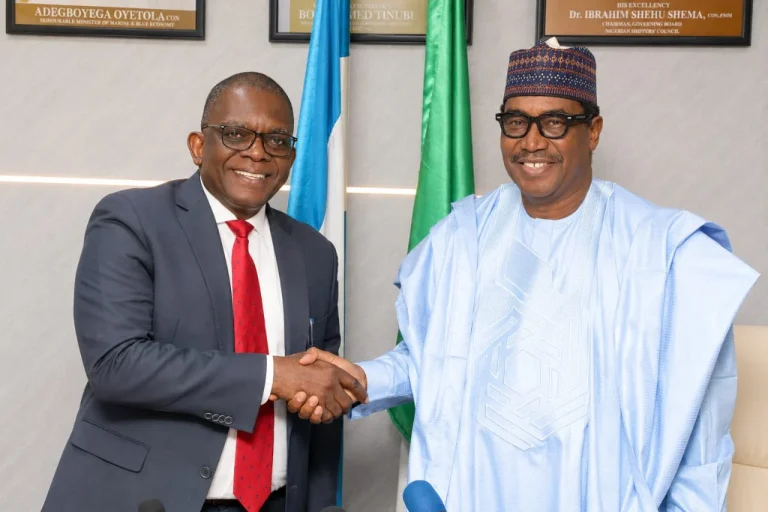
Photo: The Executive Secretary of NPERA, Dr Pius Akutah, and the Board Chairman of NPERA, Dr. Ibrahim Shema, during the press conference announcing NPERA’s commencement of operations as port ports economic regulator in Apapa.