
Govt, stakeholders agree on strategies to boost competitiveness of Nigeria’s ports, say port modernization alone not enough
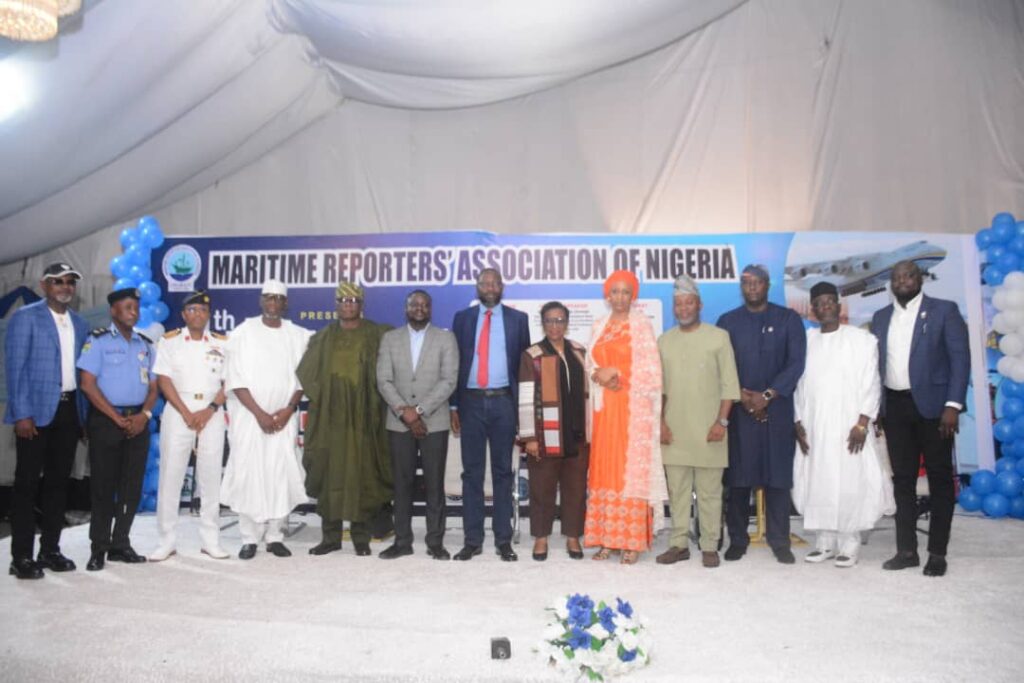
Stakeholders who attended the Maritime Reporters Association of Nigeria’s annual lecture (MAMAL 2026) were unanimous in their conviction that infrastructure investment and modernization of the ports alone will not boost the competitiveness of Nigeria’s ports with other ports in the sub-region.
The National President of the Chartered Institute of Logistics and Transport (CILT), Dr. Boboye Oyeyemi, who spoke at the event said what happens inside the ports is as important as what happens outside it, stressing that Nigeria’s port modernization efforts will not translate into economic competitiveness unless the country addresses the challenges of cargo movement beyond the ports.
Oyeyemi said modern terminals would have limited impact if cargoes continued to face delays in customs clearance, high inland transportation costs, poor infrastructure and fragmented government processes.
The logistics expert said Nigeria must move from “port modernization to logistics transformation” to maximise the benefits of its maritime assets.
According to him, the real test of Nigeria’s logistics competitiveness begins after vessels berth and containers leave the terminals.
Oyeyemi maintained that cargo must be cleared quickly, leave the ports without unnecessary delays and move efficiently by road, rail or inland waterways to factories, warehouses and markets at predictable costs.
He said the competitiveness of Nigerian manufacturers and farmers in international markets would ultimately depend on how efficiently goods could move from the point of production to global markets.
He cautioned that “a fast-growing port does not create competitiveness” on its own. “A modern terminal, for example, does not result in a modern logistics system. A digitally enabled port connected to fragmented government processes is not a fully digital supply chain. And a competitive port, whose cargoes remain expensive to move inland, cannot by itself make Nigerian goods competitive.”
The CILT president urged stakeholders to stop viewing ports as isolated facilities, and instead consider them as nodes within an integrated national logistics network, saying that ports must be seamlessly connected to customs, roads, rail, inland waterways, dry ports, warehouses, industrial clusters and markets.
Oyeyemi also stressed the importance of initiatives such as the National Single Window and Port Community System, saying the objective should go beyond merely putting existing data online.
He advocated for an integrated cargo-flow system under which government agencies and private operators could access necessary information without repeatedly demanding the same information from customers.
“The container should have one digital identity and one traceable journey. That is the future,” he said.
On port charges, Oyeyemi said the debate should focus on the total cost of moving cargo rather than whether the charge at a particular port was high or low.
He listed port and terminal charges, customs-related costs, storage, demurrage, documentation, haulage, security, inventory costs and uncertainty among factors contributing to the overall cost of cargo movement.
He therefore called for transparent and predictable charges, efficient processes and measurable service standards.
Oyeyemi further advocated greater use of rail and inland waterways to reduce Nigeria’s overwhelming dependence on roads for cargo evacuation.
He said roads should provide flexibility, while rail should be used for high-volume and long-distance cargo movement and inland waterways where commercially viable.
He also called for greater use of dry ports and logistics parks to take cargo processing closer to the hinterland.
According to him, logistics professionals must begin to think beyond individual modes of transportation and focus on the entire supply chain.
Dr. Oyeyemi said Nigeria has an opportunity to become a major logistics gateway for West and Central Africa, given its large population, geographical position, maritime assets and access to the African Continental Free Trade Area.
He said the country must transition “from terminals to networks, from documents to data, from dependence to multimodality, from import bias to export competitiveness, and from measuring individual agencies to measuring the performance of the cargo journey.”
Former Managing Director of the Nigerian Ports Authority (NPA), who is currently the Special Adviser to President Bola Ahmed Tinubu on Policy Coordination and Head of the Central Delivery Coordination Unit, Hadiza Bala Usman, agreed with these submissions, saying that port modernization must ultimately translate into measurable improvements in cargo movement, vessel and truck turnaround times, logistics costs and export capacity.
Delivering the keynote address at the event, Hadiza identified six critical pillars of modernization: infrastructure and operational models, modern equipment, digitalization, institutional reform, human capital development, and commercial modernisation covering tariffs, concessions, investment and service quality.
According to Usman, Nigerian seaports handle more than four-fifths of the country’s physical imports and exports, making their efficiency central to national economic growth.
“When port costs are high, they travel into the price of rice on the trader’s stall, the landed cost of raw materials for the manufacturer and into the exchange rate pressure created when importers pay dollar-denominated charges on top of naira-denominated uncertainties.”
Usman acknowledged improvements in Nigerian port performance, citing the World Bank and S&P Global Market Intelligence Container Port Performance Index, which ranked Tin Can Island Port 10th globally and Lagos Port Complex, Apapa, 12th among the world’s most improved container ports between 2020 and 2025.
She also pointed to rising cargo throughput, digitalization initiatives and rehabilitation of major port infrastructure as evidence that ongoing reforms were beginning to yield results.
However, she warned that the gains could only be sustained through continuous investment, effective regulation and measurable performance standards.
She observed that the reconstruction of Apapa and Tin Can Island ports, rehabilitation of Eastern ports and expansion of Lekki Deep Sea Port would not deliver their full economic potential unless backed by efficient road, rail, barge, inland logistics and dry-port connections.
“A port cannot be globally competitive if its hinterland is not competitive,” she said.
The former NPA boss also acknowledged that high charges and tariffs are inimical to Nigeria’s ports’ comprehensive, and called for a review of Nigeria’s port tariff structure, arguing that attention should move away from isolated charges to the total cost of moving cargo through the supply chain.
She expressed concern over reports that clearing a standard 20-foot container through Apapa could cost between N14 million and N15 million, compared with lower costs at the neighboring West African ports.
Usman noted that the overall cost of cargo movement encompasses statutory port tariffs, terminal handling charges, shipping-line charges, detention, demurrage, haulage, documentation and clearing costs.
She argued that eliminating duplicated and obsolete charges, as well as unnecessary regulatory interventions, could significantly reduce the cost of doing business at Nigerian ports.
However, she said, “Charges cannot remain frozen indefinitely while infrastructure deteriorates, but neither can users be required to pay any amount demanded. Tariffs must be linked to value and performance.”
She advocated a predictable, transparent and performance-based tariff regime, with tariff adjustments supported by published methodologies, international benchmarks and measurable improvements in service delivery.
Usman also proposed an annual Port Economic Performance Report covering vessel and truck turnaround times, cargo-handling productivity, equipment availability, Customs clearance, total logistics costs, digital transactions, export connectivity, customer satisfaction and dispute-resolution timelines.
The Executive Director, Operations and Technical, Tantita Security Services Nigeria Limited, Capt. Dr. Warredi Enisuoh, who was the Chairman of the event painted a sorry picture of how the neighbouring ports have been taking advantage of Nigeria’s lethargy. He was more emphatic in arguing that modernizing the port itself would achieve little if the cargo evacuation system remained dysfunctional.
“You cannot modernize a port without modernizing your exit point,” he noted.
Enisuoh argued that automating operations inside Apapa or Tin Can Island would not eliminate congestion if cargo continued to face delays outside the terminal gates.
He called for an integrated system covering cargo evacuation, roads, rail, inland waterways, truck management and the elimination of multiple checkpoints and collection points.
He cited how Togo boosted its efficiency and competitiveness by strategically investing in deeper channels and streamlined processes at Lomé Port.
According to him, the increasing size of vessels in global shipping makes deeper and more efficient ports indispensable, with some modern container vessels now exceeding 20,000 TEUs in capacity.
He therefore urged Nigeria to deepen and expand its ports urgently to accommodate larger vessels and compete more effectively with neighbouring maritime gateways.
Enisuoh also criticized the multiplicity of agencies and procedures confronting shipping agents and port users.
He said operators often have to interface separately with the NPA, Nigerian Maritime Administration and Safety Agency (NIMASA), Nigeria Customs Service and other agencies, creating delays and additional costs, and therefore, called for a genuine one-stop-shop system through which port users could complete multiple regulatory, documentation and payment requirements on an integrated platform.
The Tantita director of operations also urged the federal government to look beyond Lagos and develop Nigeria’s ports as part of a coordinated national maritime strategy.
He argued that viable alternative ports along the coastline should be strengthened to distribute cargo, reduce pressure on Lagos and establish more efficient trade corridors into the hinterland.
He warned that poor urban infrastructure around Lagos could undermine even massive investments in port facilities.
“If city infrastructure is poor, spend all the millions of dollars you want to maintain the port, it’s not going to work. You will still get congestion,” he said.
He consequently called for a national plan integrating ports, roads, bridges, rail, inland waterways, logistics hubs and cargo evacuation systems.
On the whole, all the stakeholders unanimously agreed that Nigeria’s port competitiveness would not be secured by infrastructure investment alone. They agreed that there must be infrastructure renewal, maritime security, deep-sea port development, marine assets, digitalization and economic regulation.
In addition, there must be predictable tariffs, transparency, institutional coordination and performance measurement.